In a momentous event, the Philippine Genome Center (PGC) officially launched the FILIPINOme: The Filipino Genome Sequencing Project at the University of the Philippines, PGC building, on March 26, 2026. This event signals the beginning of a significant transformation in the country’s healthcare system and scientific innovation.
The FILIPINOme Project is a flagship program of the Genome Center that aims to create the first dedicated Filipino Reference Genome for clinical use. With the support of the Department of Science and Technology (DOST) – Philippine Council for Health Research and Development (PCHRD) and the University of the Philippines (UP), this landmark initiative is set to generate population-relevant genomic data for both clinical use and research, to translate genomics into healthcare, and to advance precision medicine. Through the FILIPINOme project and by sequencing the Filipino genome, this revolutionary step in healthcare research will lead to improved disease phenotype characterization, more refined diagnoses, better rational treatment, and disease prevention strategies for every Filipino. The initiative will not only improve health outcomes but also inform public health policy and advance precision medicine for the Filipino people.
A diverse group of stakeholders and representatives from supporting agencies and institutions attended the launch. Honored guests who graced the event came from the Department of Health (DOH), Philippine Council for Health Research and Development (PCHRD), Department of Science and Technology (DOST), UP officials and members of the Board of Regents (BOR), Philippine General Hospital (PGH), Philippine Heart Center, University of the Philippines Manila, Commission on Higher Education (CHED), British Embassy Manila, British Council and the World Health Organization (WHO). Esteemed faculty members and experts were also present from the UP DNA Analysis Laboratory, Natural Science Research Institute, UP Institute of Biology, UP National Institute of Molecular Biology and Biotechnology, as well as executive committee members of PGC.
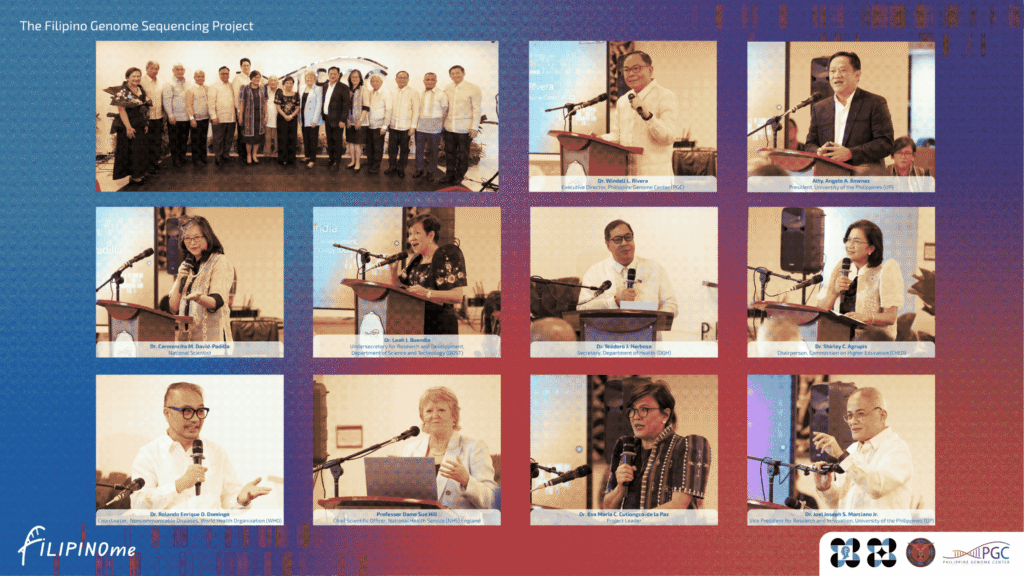
The program commenced with welcome remarks from Dr. Windell L. Rivera, Executive Director of the Philippine Genome Center, followed by messages from Atty. Angelo A. Jimenez, President of the University of the Philippines; National Scientist Dr. Carmencita M. David-Padilla; Dr. Leah J. Buendia, Undersecretary for Research and Development of the Department of Science and Technology; Dr. Teodoro J. Herbosa, Secretary of the Department of Health; Dr. Shirley C. Agrupis, Chairperson of the Commission on Higher Education; Dr. Rolando Enrique D. Domingo, Coordinator for Noncommunicable Diseases at the World Health Organization; Professor Dame Sue Hill, Chief Scientific Officer of the National Health Service (NHS) England; Dr. Eva Maria Cutiongco-de la Paz, Project Leader of FILIPINOme; and Dr. Joel Joseph S. Marciano Jr., Vice President for Research and Innovation at the University of the Philippines.
The highlight of the program was the keynote presentation by the Guest of Honor, Professor Dame Sue Hill, Chief Scientific Officer of the National Health Service (NHS) England. In her talk titled “Genomic and Healthcare: Lessons Learnt from the UK,” she discussed the challenges facing healthcare systems around the world—driven by deteriorating health conditions, an increasing number of long-term conditions, and the rising costs of healthcare delivery due to outdated methods. She emphasized that life sciences are at the heart of the shift in the delivery of health care. With genomics at the forefront, she shared that the UK has made massive strides in the NHS in England to implement genomic medicine and transform care, through their involvement in the Human Genome Project and in the delivery of the 100,000 Genomes Project—creating a national infrastructure and asset from a high-profile cohort study. This laid the foundations for the NHS Genomic Medicine Service. She concluded by emphasizing the importance of aligning research and innovation and clinical services to create a learning system and to drive the transformation and delivery of healthcare.
Following this, Project Leader Dr. Eva Maria Cutiongco-de la Paz, who formally led the official launch of the Filipino Genome Sequencing Project (FILIPINOme), described the program as a foundational first step toward fostering innovative, multi-stakeholder partnerships for the future practice of precision medicine in the Philippines. In her presentation, Dr. Cutiongco-de la Paz discussed the lack of representation in genomic databases in the country as a barrier to translating genomics into clinical practice. Through the FILIPINOme, a dedicated Filipino Reference Genome for clinical use is on the horizon—a national genomic database will serve as a repository of shared knowledge on the impact of genetics on the health of Filipinos. In closing, she emphasized: “We may think that resource-limited settings such as ours may not seem to be an appropriate place to employ cutting-edge precision medicine approaches and technologies, but it is precisely in these resource constraints that make precision medicine highly relevant and perhaps even more practical than relying on traditional trial-and-error approaches. For this to happen, we need our own reference sequence.”
At the heart of the event, a shared theme and message among the thought-leaders during the insightful presentations was that the FILIPINOme, as a flagship program, underscores the urgency for positive change not only in the healthcare system of the country but its ripple effect on the applications of OMIC technologies, policy development for precision medicine, and research engagement, all toward building a healthy future for every Filipino.
The FILIPINOme represents a vital contribution to science-led transformation in Philippine healthcare.