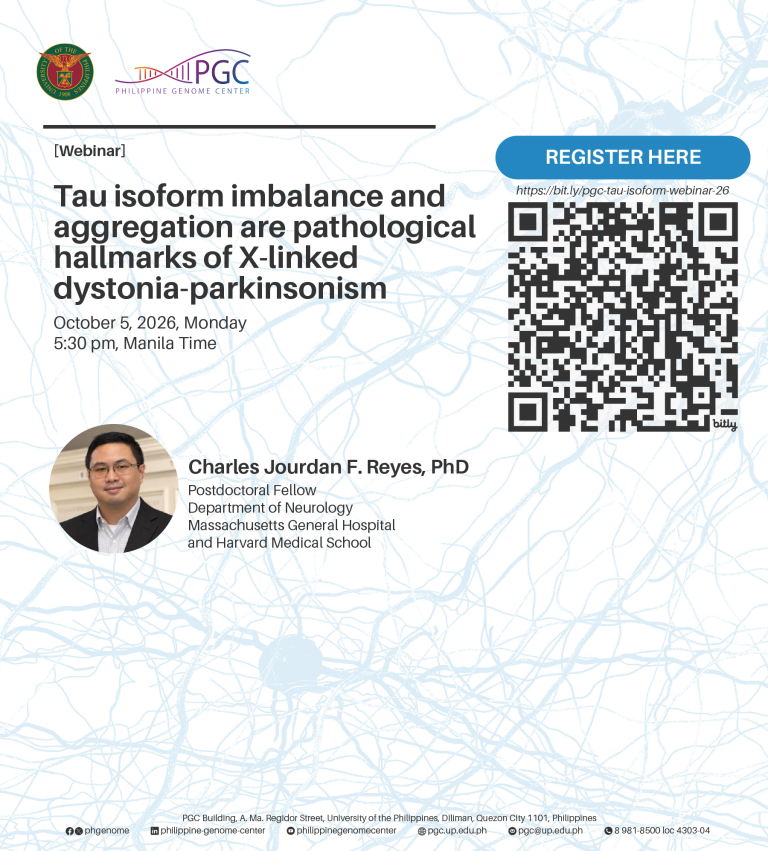
[Webinar] Tau isoform imbalance and aggregation are pathological hallmarks of X-linked dystonia-parkinsonism
Date: October 5, 2026 | Monday | 5:30 PM, Manila Time
Abstract:
Tauopathies encompass diverse neurodegenerative diseases unified by aberrant patterns of tau deposition in the brain. Although most appear sporadic, some are linked to genetic etiologies that offer unique mechanistic insights. Here, we report that X-linked Dystonia-Parkinsonism (XDP), caused by a non-coding retrotransposon-associated repeat insertion in TAF1, involves a significant imbalance of tau isoforms and the accumulation of hyperphosphorylated, four-repeat tau in the brain. In striatal tissue, both misfolded tau accumulation, predominantly in astrocytes, and MAPT exon 10 inclusion correlated with repeat length within the causal insertion. Transcriptomic profiling across brain regions revealed dysregulation of known tau-related pathways. Levels of phosphorylated tau181, glial fibrillary acidic protein, and neurofilament light chain were elevated in patient plasma and discriminated XDP from controls. These findings implicate defective tau proteostasis as a key pathogenic mechanism and position XDP as a genetic model for uncovering cellular drivers that may disrupt tau in other, more common neurodegenerative diseases.
About the Speaker:
Charles Jourdan F. Reyes, PhD
Postdoctoral Fellow
Department of Neurology | Massachusetts General Hospital and Harvard Medical School
Charles Jourdan Reyes is a postdoctoral research fellow at the Collaborative Center for X-linked Dystonia-Parkinsonism (CCXDP) at Massachusetts General Hospital and Harvard Medical School. His research focuses on the intersection of DNA repeat expansions, RNA metabolism, and neurodegeneration in X-linked dystonia-parkinsonism (XDP), a rare movement disorder endemic to Panay Island in the Philippines. Charles received his BS in Biology from Ateneo de Manila University, his Master of Medical Science from Osaka University in Japan through a MEXT scholarship, and his PhD in Biomedicine from the University of Lübeck in Germany through a KAAD scholarship. He aspires to become a leading researcher and educator in the biomedical sciences and to contribute to the development of treatments for neurodegenerative diseases. Beyond the laboratory, he is committed to promoting neuroscience in the Philippines and mentoring aspiring Filipino scientists.
For questions, email or call us at:
[email protected] | +63-2-8981-8500 Local 4703